
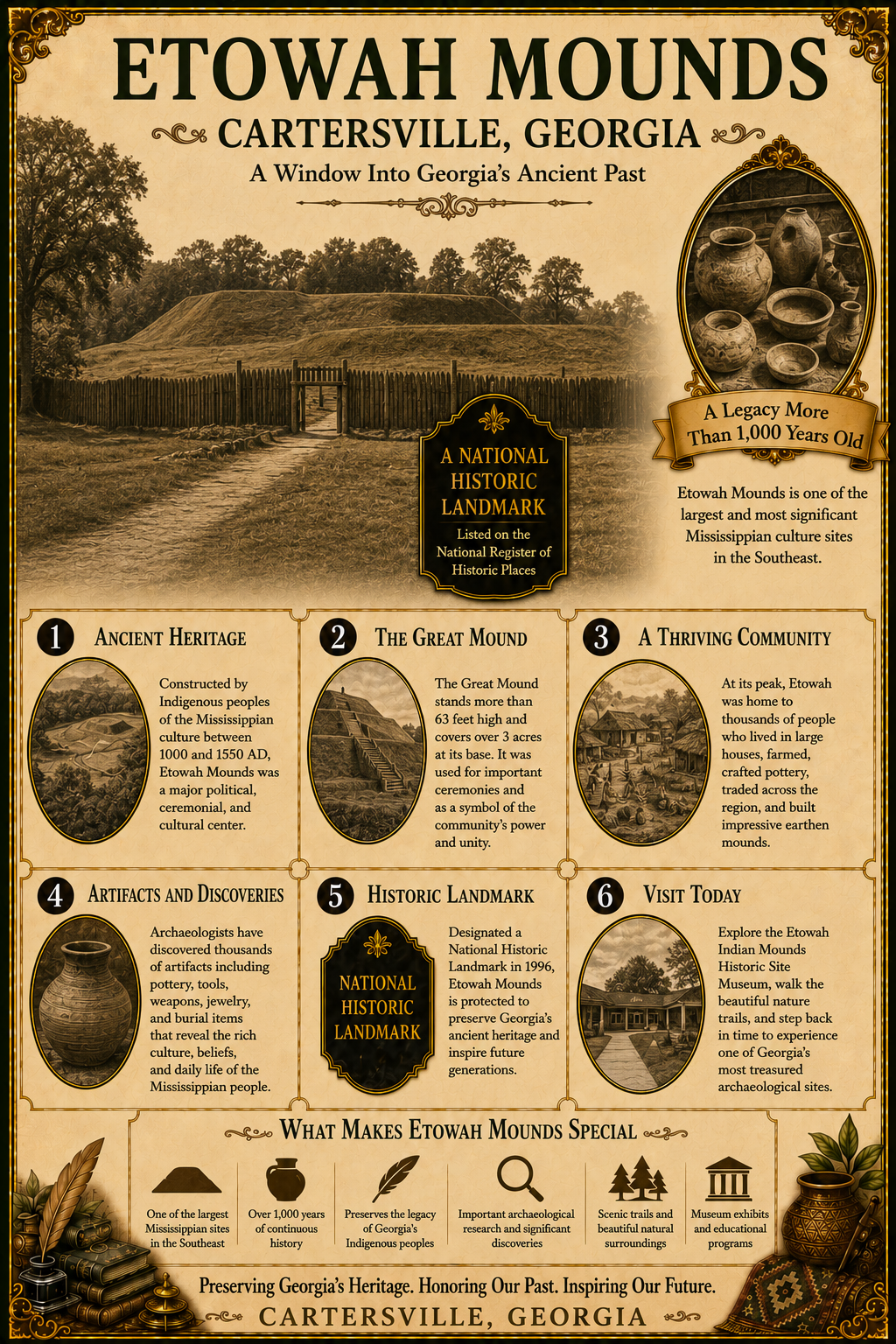
Etowah Mounds is one of the largest and most significant Mississippian culture sites in the Southeast.
Listed on the National Register of Historic Places
Constructed by Indigenous peoples of the Mississippian culture between 1000 and 1550 AD,
Etowah Mounds was a major political, ceremonial, and cultural center.
The Great Mound stands more than 63 feet high and covers over 3 acres at its base.
It was used for important ceremonies and as a symbol of the community’s power and unity.
At its peak, Etowah was home to thousands of people who lived in large houses,
farmed, crafted pottery, traded across the region, and built impressive earthen mounds.
Archaeologists have discovered thousands of artifacts including pottery, tools, weapons, jewelry,
and burial items that reveal the rich culture, beliefs, and daily life of the Mississippian people.
Designated a National Historic Landmark in 1996, Etowah Mounds is protected to preserve
Georgia’s ancient heritage and inspire future generations.
Explore the Etowah Indian Mounds Historic Site Museum, walk the beautiful nature trails,
and step back in time to experience one of Georgia’s most treasured archaeological sites.

Visiting Etowah Indian Mounds State Historic Site, Cartersville Georgia
Etowah Mounds is one of the most important archaeological sites in the southeastern United States and
was the political, ceremonial, and economic center of the Mississippian culture.
Built between A.D. 1000 and 1550 by Native Americans, the site includes six earthen mounds,
village areas, and a royal acropolis surrounded by a wooden palisade wall.
Archaeological excavations have uncovered thousands of artifacts, including pottery, tools, jewelry, and the
world-famous Etowah Statue, a masterpiece of Mississippian art.
Today, Etowah Mounds is a National Historic Landmark, preserving the rich heritage and legacy of the Native peoples who lived and thrived here.
Color in me.

Drag & drop or click to select
JPEG, PNG, GIF, WebP, MP4, WebM · Images max 8 MB · Videos max 100 MB