
Calhoun Mine – Lumpkin County, Georgia
Calhoun Mine – Lumpkin County, Georgia
Calhoun Mine is one of Georgia’s oldest and most historically significant gold-mining sites. Located about three miles south of
Dahlonega near the Chestatee River, the mine is closely associated with the beginning of the Georgia Gold Rush
and the dramatic transformation of North Georgia during the late 1820s and early 1830s.
Discovery of Gold
The exact location and date of Georgia’s first gold discovery remain uncertain. Reports of gold in the region appeared during the
early 1800s, and several individuals later claimed credit for making the discovery that started the rush.
According to a widely repeated local account, Benjamin Parks discovered gold on the property that later became
Calhoun Mine in 1828. Parks reportedly noticed an unusual deposit while deer hunting, examined the soil, and found it to be exceptionally rich in gold.
News of discoveries throughout the region spread rapidly. By 1829, the Georgia Gold Rush was underway, drawing thousands of prospectors into the mountains.
Miners arrived on foot, horseback, and in wagons, establishing temporary camps and helping create rapidly growing communities throughout North Georgia.
Ownership and the Calhoun Name
At the time of the discovery, the property was owned by Reverend Robert Obarr, a Baptist minister. Obarr later sold the land to Judge Underwood.
The property was eventually purchased by John C. Calhoun of South Carolina, one of the most prominent American political leaders of the 19th century.
During his long public career, Calhoun served as vice president of the United States, secretary of war, secretary of state, and a United States senator.
The mining property became known as Calhoun Mine because of his ownership.
Members of the Calhoun family continued to hold an interest in the land until the 1880s.
Mining at Calhoun Mine
The earliest mining operations relied on simple hand tools, including gold pans, picks, shovels, and rock hammers.
Miners first searched for placer gold—small pieces of loose gold found in streambeds, gravel, and surface soil.
As those deposits became harder to find, miners began cutting into the hillsides and digging underground to reach gold-bearing quartz veins.
Over time, numerous cuts, shafts, and tunnels were excavated throughout the property. The original Calhoun Cut extends approximately
150 feet into a ridge. Additional tunnels were created as miners followed the underground veins deeper into the earth.
Later mining operations introduced more advanced methods. Hydraulic mining used powerful streams of water to wash
away soil and expose gold-bearing material. A historic photograph dating from around 1900 shows a water cannon
being operated at Calhoun Mine during a renewed period of activity.
Mining continued intermittently into the 20th century. Additional excavations were made during the 1940s, including the
Dugas Tunnel and the approximately 500-foot Abbot Tunnel. The surviving features at the site represent more than a century of mining
— from the earliest years of the Georgia Gold Rush through the period following World War II.
Connection to the Georgia Gold Rush
Calhoun Mine became one of the best-known mining properties in the Dahlonega area.
Within a short period after the major discoveries, thousands of miners were working throughout the North Georgia goldfields.
The rush helped establish Dahlonega as the commercial center of Georgia’s mining region.
Boardinghouses, supply stores, workshops, transportation services, and mining companies developed to serve the growing population.
In 1838, the federal government opened a branch of the United States Mint in Dahlonega.
The mint produced gold coins using metal extracted from mines throughout the surrounding region,
further strengthening Dahlonega’s connection to the nation’s early gold-mining industry.
Cherokee Lands and Removal
The history of Calhoun Mine is also connected to one of the most tragic periods in Georgia history.
Much of the gold-mining region was located within the homeland of the Cherokee Nation.
As white prospectors entered Cherokee territory, many ignored treaties, property rights, and federal restrictions.
Cherokee residents were sometimes forced away from their mining sites, while their tools, land, and property were taken or destroyed.
The discovery of gold increased pressure from Georgia officials and settlers to seize Cherokee lands.
The state extended its authority over Cherokee territory and distributed portions of the land to white settlers.
These actions contributed to the larger campaign that eventually resulted in the forced
removal of the Cherokee people during the 1830s, remembered today as the Trail of Tears.
This history is an essential part of understanding the Georgia Gold Rush. The region’s mining wealth brought
economic growth and settlement, but it also intensified the displacement and suffering of the Cherokee Nation.
Later History and Preservation
After the most productive years of the gold rush had passed, mining at Calhoun Mine continued at different times
under various owners and operators. New technology occasionally made it profitable to revisit older workings
and search for gold that earlier miners had been unable to recover.
The property still contains visible evidence of its long mining history, including cuts, tunnels, shafts, water channels, and altered landscapes.
Together, these features show how mining methods changed from small-scale prospecting with hand tools to larger and more mechanized operations.
Why Calhoun Mine Matters
Calhoun Mine preserves an important part of Georgia’s industrial, economic, and social history.
It represents the excitement and hardship of the Georgia Gold Rush, the development of early mining technology, and the growth of Dahlonega as a regional center.
The site also provides a reminder that the story of the gold rush cannot be separated from the history of
Cherokee dispossession and removal. Calhoun Mine therefore stands as both a symbol of early American mining and a place
where visitors can reflect on the complex consequences of westward expansion, economic ambition, and changing control of the land.
.
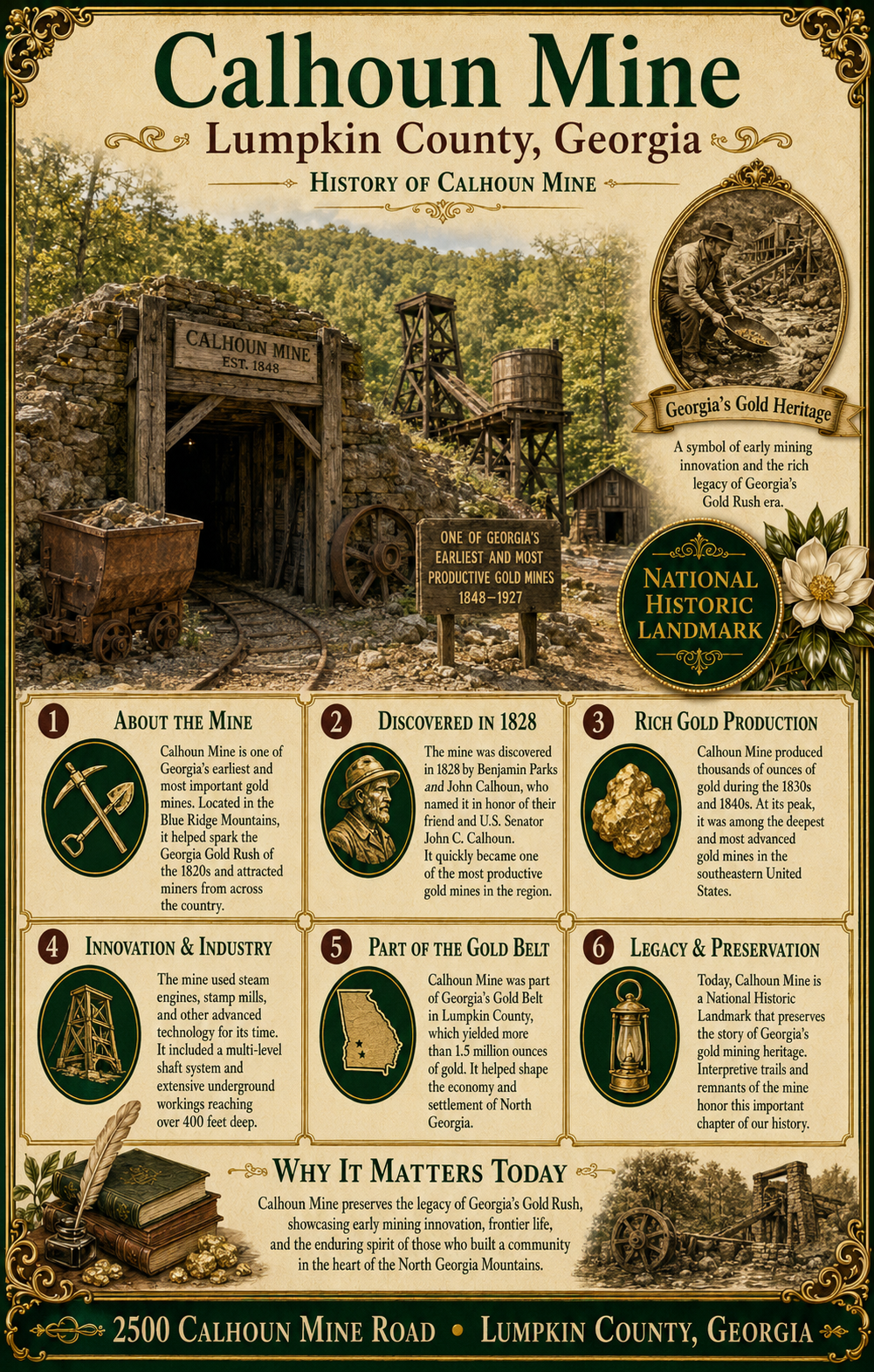
Calhoun Mine
Lumpkin County, Georgia
History of Calhoun Mine
Georgia’s Gold Heritage
A symbol of early mining innovation and the rich legacy of Georgia’s Gold Rush era.
National Historic Landmark
One of Georgia’s earliest and most productive gold mines, 1848–1927
About the Mine
Calhoun Mine is one of Georgia’s earliest and most important gold mines.
Located in the Blue Ridge Mountains, it helped spark the Georgia Gold Rush of the 1820s and attracted miners from across the country.
Discovered in 1828
The mine was discovered in 1828 by Benjamin Parks and John Calhoun, who named it in honor of their friend and
U.S. Senator John C. Calhoun. It quickly became one of the most productive gold mines in the region.
Rich Gold Production
Calhoun Mine produced thousands of ounces of gold during the 1830s and 1840s.
At its peak, it was among the deepest and most advanced gold mines in the southeastern United States.
Innovation and Industry
The mine used steam engines, stamp mills, and other advanced technology for its time.
It included a multilevel shaft system and extensive underground workings reaching more than 400 feet deep.
Part of the Gold Belt
Calhoun Mine was part of Georgia’s Gold Belt in Lumpkin County, which yielded more than 1.5 million ounces of gold.
It helped shape the economy and settlement of North Georgia.
Legacy and Preservation
Today, Calhoun Mine is a National Historic Landmark that preserves the story of Georgia’s gold-mining heritage.
Interpretive trails and remnants of the mine honor this important chapter of our history.
Why It Matters Today
Calhoun Mine preserves the legacy of Georgia’s Gold Rush, showcasing early mining innovation, frontier life,
and the enduring spirit of those who built a community in the heart of the North Georgia Mountains.
Address:
2500 Calhoun Mine Road
Lumpkin County, Georgia

Exploring the Consolidated Gold Mine
tour in Lumpkin County, Georgia
Color me in image of Calhoun Mine – Lumpkin County
